GNSS jamming and spoofing are forms of interference with the satellite positioning signals that ships rely on to know where they are. GNSS, the Global Navigation Satellite System, is the umbrella term covering the US GPS, the EU’s Galileo, Russia’s GLONASS, and China’s BeiDou. When those signals are jammed or spoofed, a vessel can lose its position entirely or be fed a false one, with consequences that ripple through navigation, safety, and the wider maritime picture. This explainer covers what the two are, how they differ from AIS spoofing, and why they matter.
Jamming and spoofing are not the same
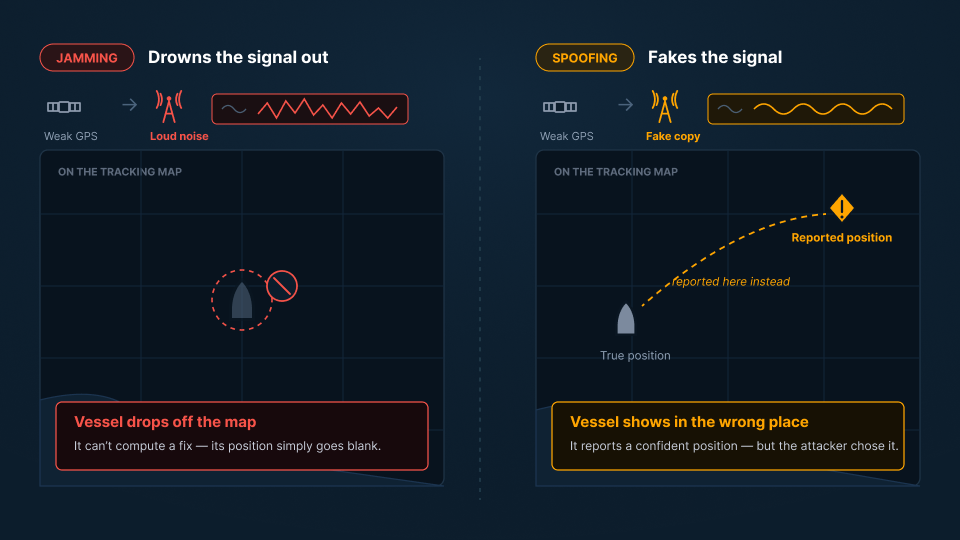
The two attacks work differently:
- Jamming floods the relevant frequencies with noise so that a receiver cannot lock onto the genuine satellite signal. The effect is denial: the vessel is left without a position, positionally blind.
- Spoofing transmits counterfeit signals that imitate the real ones, so the receiver computes a position or time that is wrong. The effect is deception: the vessel believes a false fix, often without realizing it.
Spoofing is generally the harder of the two to detect, because a plausible false position raises no alarm on the receiver, whereas a jammed receiver at least knows it has lost signal.
How this differs from AIS spoofing
The distinction matters, because the two are often confused. AIS spoofing falsifies the message a vessel broadcasts about itself. GNSS spoofing corrupts the underlying position the vessel calculates in the first place. (See: What Is AIS Spoofing.)
The connection is that they can compound. A vessel whose GNSS is spoofed may transmit, through AIS, a position it genuinely but wrongly believes to be true. In that case even an honest operator broadcasts a false location, because the error entered upstream, at the positioning signal. GNSS interference therefore corrupts the self-reported picture at its source, not only when a vessel intends to deceive.
Why it matters now
GNSS interference has moved from an occasional nuisance to a persistent feature of several regions. Widespread jamming and spoofing have been reported across the Baltic Sea, particularly around Kaliningrad, and in the Black Sea, the Red Sea, the Gulf, and the Eastern Mediterranean. In January 2026, more than a dozen coastal nations issued a joint warning over interference threatening maritime safety, and independent monitoring has recorded spoofing becoming more systematic and geographically widespread through 2026. Much of the Baltic activity has been attributed to electronic warfare associated with the war in Ukraine.
For vessels, the consequences reach safety, navigation, offshore operations, and search and rescue. For anyone building a maritime picture, the deeper implication is that position, the most basic fact about a vessel, can no longer be taken on trust from the vessel’s own systems. (See: Why AIS Alone Is Not Enough for Maritime Security.)
Why imagery gives a position you can trust
The answer to a corrupted positioning signal is a position that does not depend on it. Imagery of the water observes a hull directly, fixing where a vessel actually is regardless of whether its GNSS has been jammed or spoofed. Correlating that independent observation against the self-reported picture is what reveals interference: a vessel whose broadcast position sits far from where it is observed is either deceiving or being deceived, and either way the discrepancy is the signal. (See: How Satellite Vessel Detection Works and What Is Maritime Domain Awareness.)
From corrupted signal to ground truth
When the positioning signal itself is under attack, self-reported location cannot be the final word. SynMax delivers the capability to establish position independently through Theia, observing where vessels actually are and correlating that against what they report, so a jammed or spoofed fix does not become an accepted fact.
That is the standard we hold to across everything we build: Ground Truth for Every Decision.
If your team operates where GNSS interference is a risk, request a demo and we will show you what independent positioning looks like in your area of interest.