

Industry Solutions
Financial Services
Know-your-vessel screening and continuous monitoring for the hulls behind your transactions, built on observation rather than attestation.
The Problem

The transaction is clean on paper. The vessel is the question.
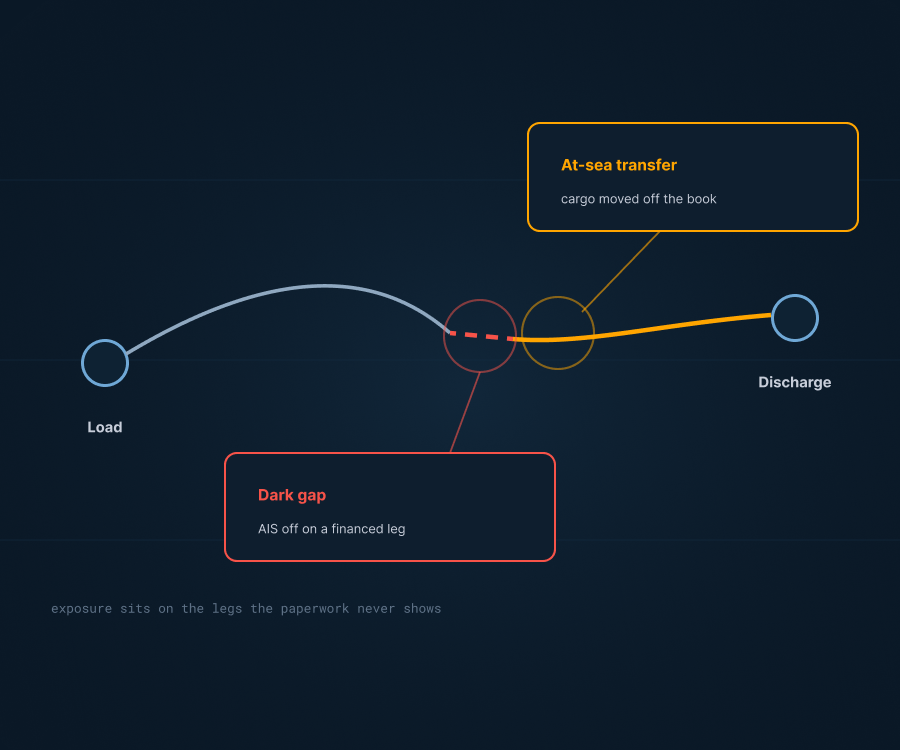
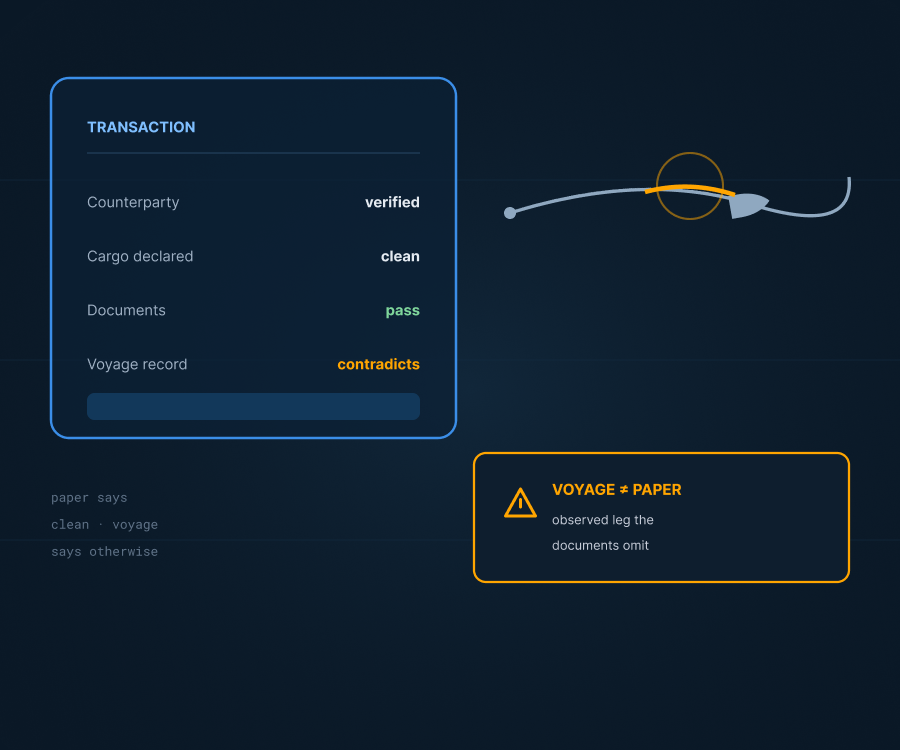
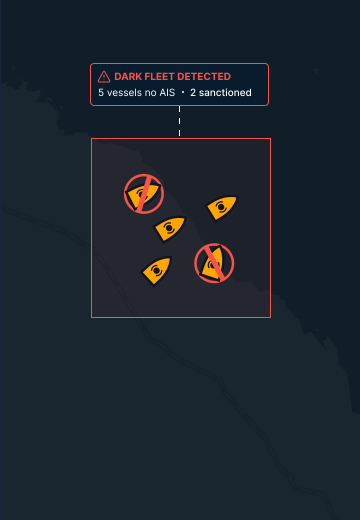
Banks, trade finance desks, and commodity houses face sanctions exposure through the vessels that carry the trades they fund. Attestations and document checks are necessary, and they are also exactly what evasive operators are structured to pass: clean paperwork over a hull that went dark, transferred cargo at sea, or called at a port it never declared.
Theia lets compliance and risk teams test the claim against the voyage. Verified identity on the hull behind each transaction, observed behavior across the financing period, and continuous monitoring on flagged entities so a vessel that changes its pattern surfaces before the exposure does.
Compliance Monitor
[ + 44.03 ]
Capabilities
Where Theia does the work.


Transaction Lifecycle
Where it enters the financing workflow.

01 / Screen
Screen Before Funding
Know-your-vessel due diligence on the hull behind the transaction: verified identity, ownership and flag history, sanctions exposure assessed on observed movements rather than declared ones.

02 / Monitor
Monitor the Financed Voyage
Between drawdown and delivery, the voyage is watched: dark legs, at-sea transfers, undeclared port calls, and deviations from the stated route surface as alerts while the exposure is still open.

03 / Escalate
Escalate with Evidence
When something surfaces, compliance gets a documented finding rather than a hunch: structured reports with imagery, measurements, and lineage that support a hold, an inquiry, or a filing.
Regulatory Context
Attestations are no longer enough.
The regulatory frame is explicit. Joint guidance from OFAC, the U.S. State Department, and the Coast Guard directed the maritime and financial sectors to address deceptive shipping practices, and the price cap regime on Russian oil rests on an attestation model that regulators themselves acknowledge can be gamed. Institutions that rely on attestations alone are holding exactly the risk that verification is designed to remove.
- Screen the hull, not just the counterparty and the documents
- Verify voyage behavior across the financing window
- Detect the events attestations conceal: dark legs, transfers, undeclared calls
- Maintain continuous monitoring on flagged entities and vessels
- Hold evidence that supports holds, inquiries, and filings under audit
Regulatory Watch
[ + 51.08 ]
LAT: 25.2048° N
LONG: 55.2708° E
FAQ
Common questions.
Q1
How does this fit an existing sanctions program?
It complements screening rather than replacing it. List-matching and KYC establish who you are dealing with; behavior verification establishes what the vessel actually did. The gap between those two is where the exposure lives.
Q2
What is the deliverable?
Alerts during the exposure window and structured evidence reports on demand: imagery, measured features, confidence, and full lineage per finding, suitable for the compliance file.

Q3
Do we need maritime analysts to use it?
No. Findings arrive as decision-ready conclusions with the evidence attached. Teams that want to go deeper can, but the default output is an answer, not a dataset.
Get Started
Screen the voyage, not just the documents.
Request a demonstration and see verified vessel behavior behind a live transaction profile.