
Industry Solutions
Maritime Insurance
Underwrite and pay claims on verified vessel behavior, not declarations. Historical records, sanctions exposure, and identity you can defend.
The Problem

The vessels that cost you are built to pass your screening.
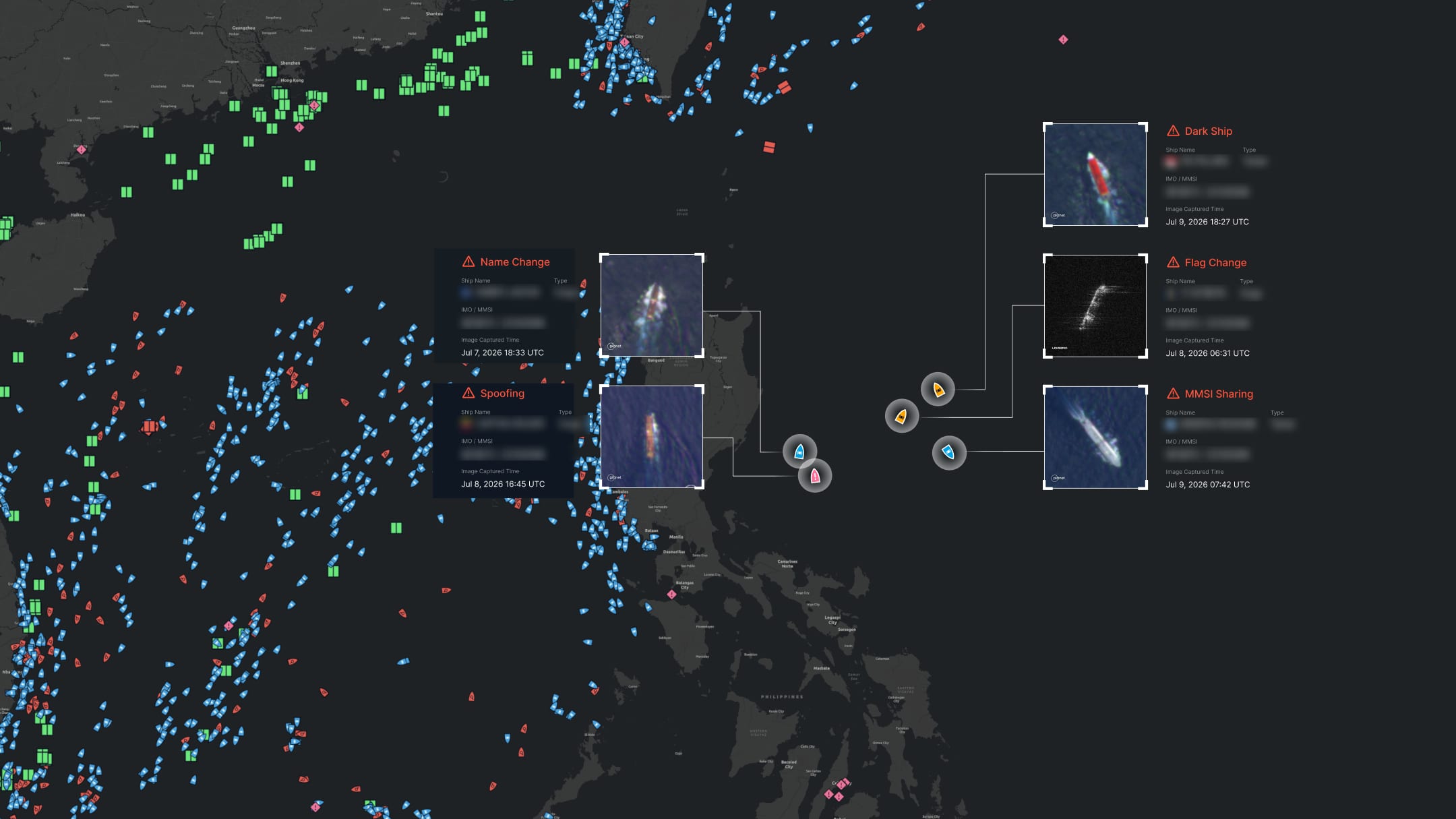
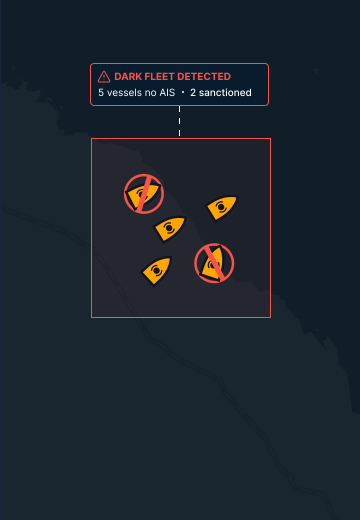
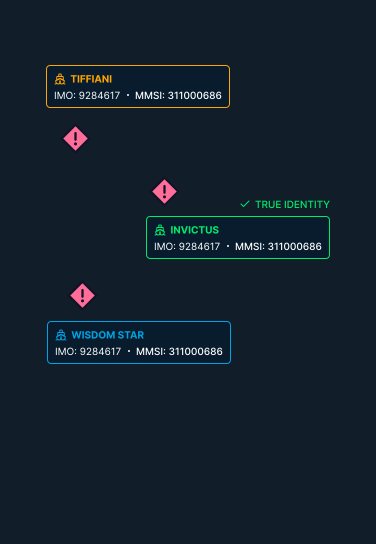
Underwriting and claims decisions rest on what a vessel declares: its identity, its route, its compliance. The vessels that create losses are precisely the ones that falsify those declarations. Shadow-fleet hulls with opaque ownership, spoofed positions during sensitive legs, and undeclared transfers at sea all survive a paperwork review by design.
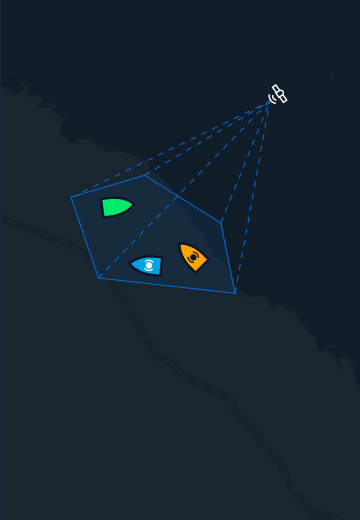
Theia replaces declarations with observation. Verified identity resolved against the physical hull, behavioral history across years of record, sanctions exposure assessed on where a vessel actually went, and ongoing monitoring so risk is priced on the vessel as it is now, not as it looked at binding.
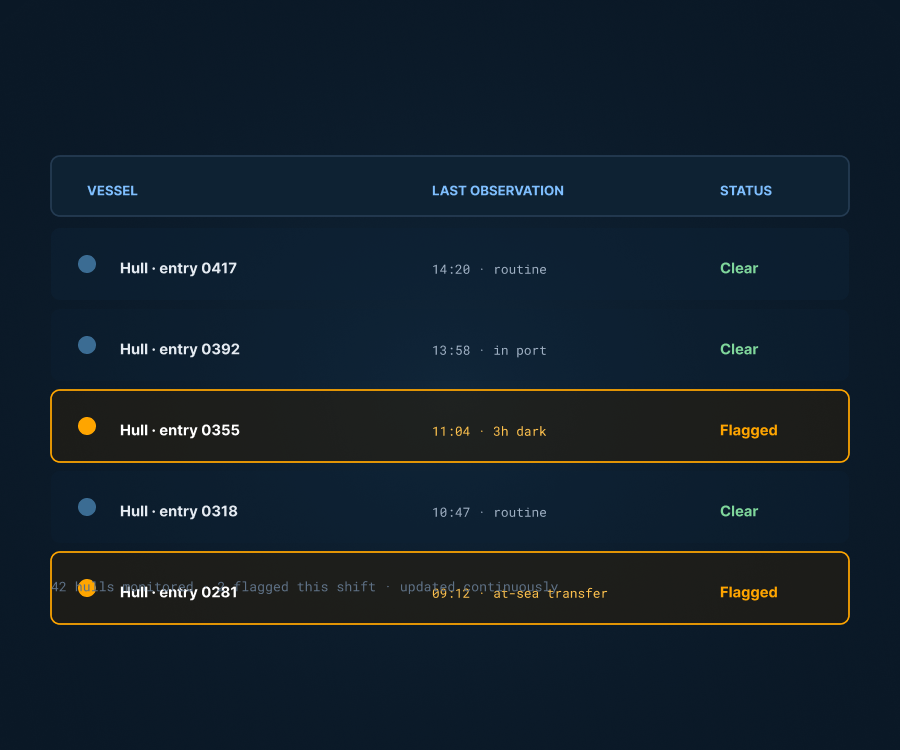
Risk Monitor
[ + 31.07 ]
Capabilities
Where Theia does the work.


Underwriting Lifecycle
Where it enters the insurance workflow.

01 / Bind
Screen at Binding
Before a vessel enters the book: identity verified against the physical hull, ownership and flag history assembled, behavioral record examined for dark legs, spoofing, and undeclared transfers. The premium prices the vessel as it actually operates.

02 / Hold
Monitor in Force
Risk changes after binding. Continuous monitoring flags the events that move it: a reporting gap in sensitive waters, a transfer at sea, a flag change, a call at a sanctioned port. The book reflects the vessel as it is now.

03 / Pay
Verify at Claim
When a claim arrives, the voyage can be reconstructed from imagery already collected: where the vessel actually went, what it actually did, and whether the loss narrative matches the observed record.
Regulatory Context
The compliance bar has already moved.
Regulators have put the burden on the market. OFAC and its UK and EU counterparts have issued advisories directing insurers, P&I clubs, and their intermediaries to detect deceptive shipping practices as part of sanctions compliance. An underwriting process that cannot see those behaviors cannot demonstrate that it screened for them.
- Monitor for AIS manipulation and reporting gaps across the insured fleet
- Scrutinize ship-to-ship transfer activity, declared and undeclared
- Assess vessel history: flag hopping, ownership changes, prior concealment
- Maintain ongoing monitoring rather than point-in-time screening
- Hold evidence that stands up in the claims file and in front of a regulator
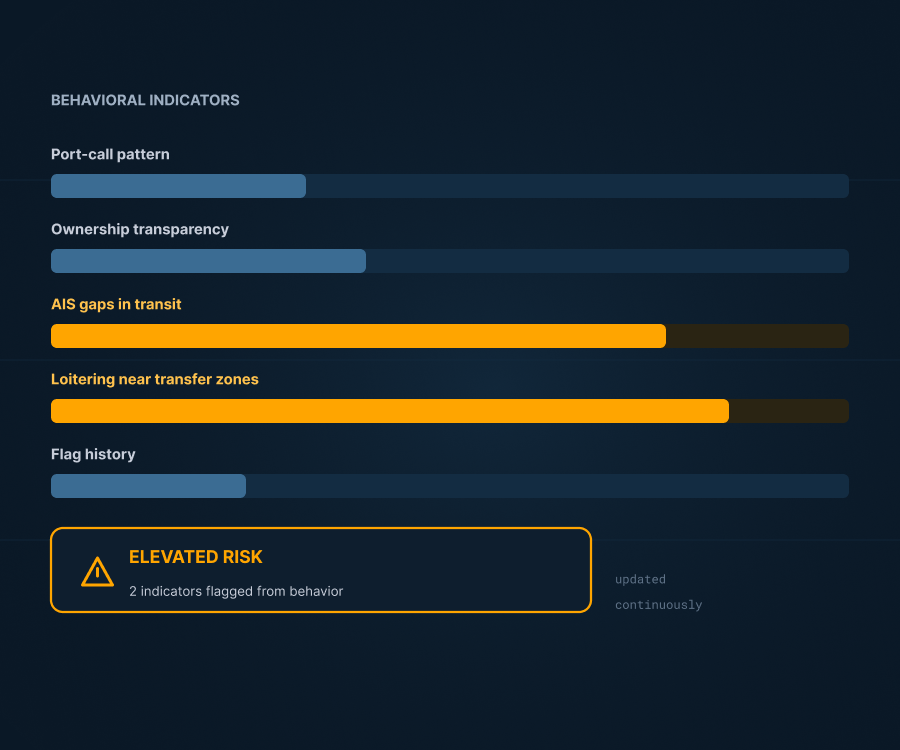
Compliance Register
[ + 38.19 ]
FAQ
Common questions.
Q1
What does verified mean here?
It means checked against physical observation. A declaration, an AIS track, or an attestation is a claim; a hull observed in imagery, measured, and matched to a record is evidence. The difference is what stands up when a decision is challenged.

Q2
Can the output go in an underwriting or claims file?
Yes. Findings are delivered as structured reports carrying the imagery, the measurements, the confidence assessment, and the lineage behind each conclusion.
Q3
How far back does the record go?
Collection runs continuously across the domain, so vessels carry years of temporal record. A hull flagged today can be investigated backward through imagery that was collected before anyone asked.
Further Reading
From the resources library.
Get Started
Price the vessel, not the paperwork.
Request a demonstration and see verified behavioral history on the hulls in your book.