How a maritime intelligence provider collects observation matters as much as which sensors it uses. Two collection models dominate, and they lead to fundamentally different capabilities. Tip-and-cue is targeted and reactive. Persistent monitoring is broad and continuous. Anyone evaluating a provider should understand the difference, because it determines not only what can be seen now but what can be reconstructed later. This analysis compares the two.
How tip-and-cue works
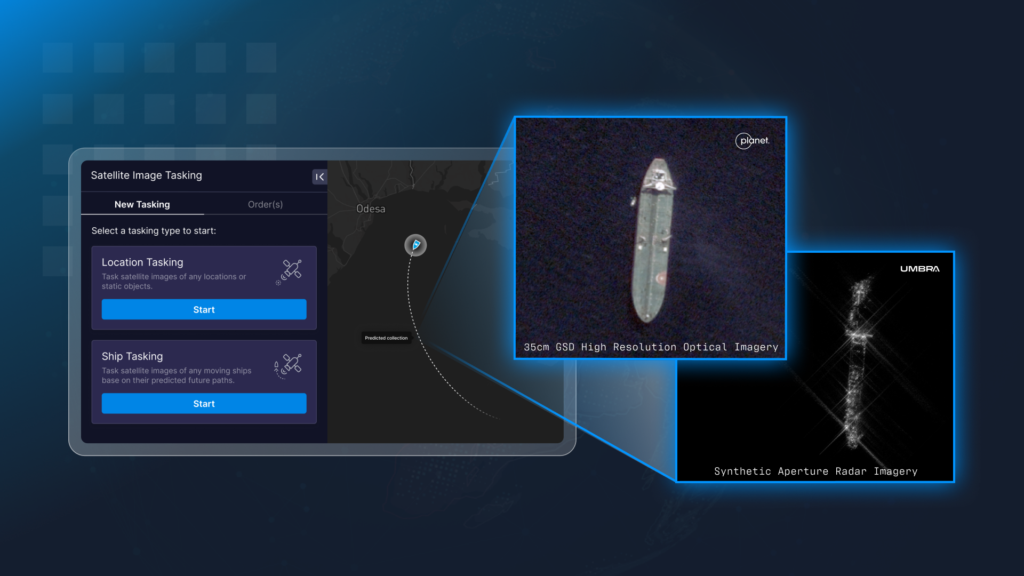
Tip-and-cue is a sequential model. A cueing source detects something of note, the tip, and a collection asset is then tasked to image that specific location, the cue. A wide-area or lower-resolution signal flags a position, and a higher-resolution sensor is directed to take a closer look.
For a known target, this is efficient. It concentrates expensive collection on the places that have already earned attention, and it avoids the cost of imaging empty ocean. It is a sound approach when you already know what you are looking for and where.
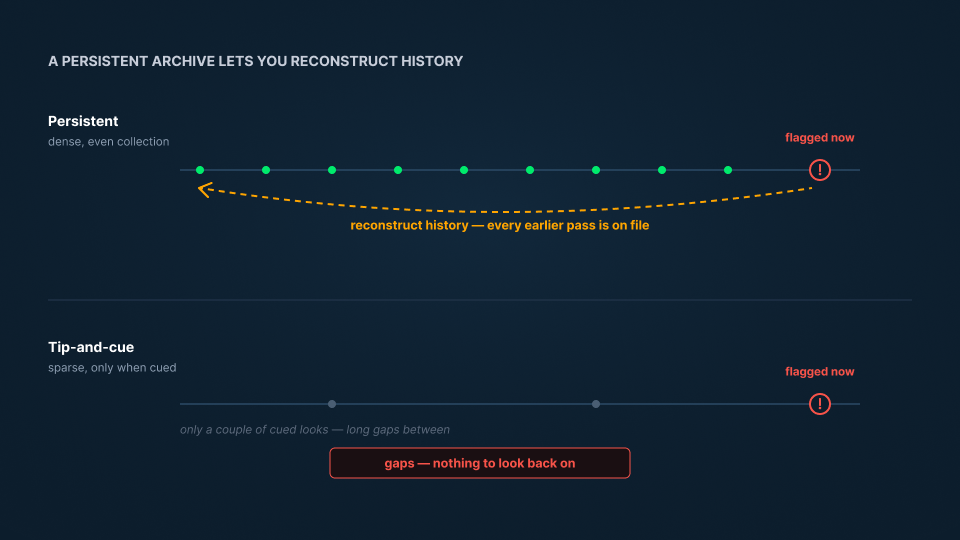
Its limits follow from its logic. There is latency between the tip and the cue, during which the target moves. The system only ever collects what it is told to collect, so anything not cued is never observed. And, most consequentially, there is no record of what was not cued. If a vessel was not of interest at the time it passed, no image exists to return to.
How persistent monitoring works
Persistent monitoring inverts the model. Rather than cueing individual targets, it collects broadly and continuously across an area, imaging what is there whether or not any particular vessel has drawn attention. It is not gated target by target, so it removes the reactive bottleneck, and because it runs constantly, it accumulates coverage of vessels no one had flagged.
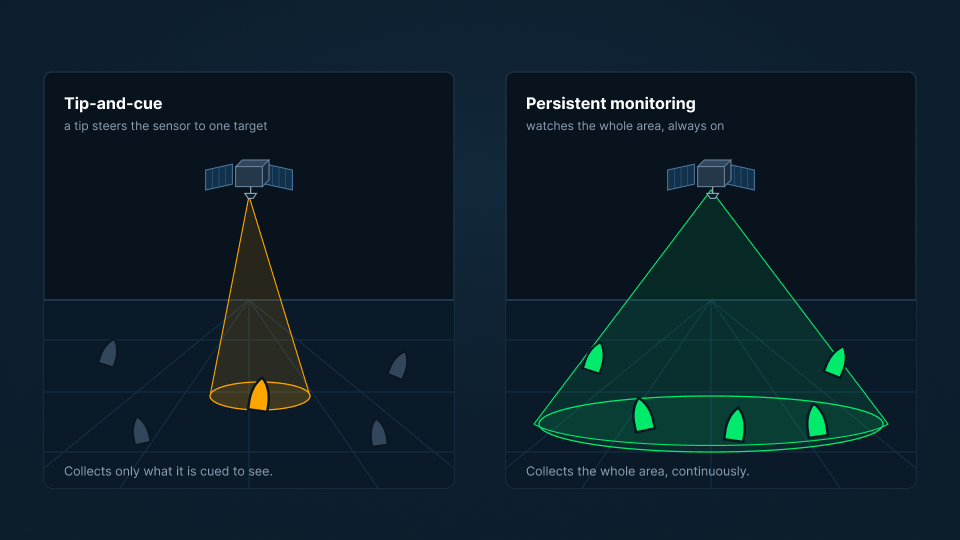
The trade-off is real and worth stating plainly. Persistent collection at scale is a heavier undertaking than cueing a single sensor, and it is not the cheapest way to look at one known ship. Its advantage is everything beyond that single ship: discovery of activity no one thought to cue, and a growing archive of the entire area.
Why the difference matters
The two models diverge most sharply on two questions.
The first is discovery. Tip-and-cue can only find what something else already tipped. It is poorly suited to surfacing the vessel that no prior signal flagged, which is often exactly the vessel that matters, because concealment is designed to avoid generating a tip. Persistent monitoring observes it anyway, because it was imaging the whole area regardless. (See: How Satellite Vessel Detection Works.)
The second is retrospection. When a vessel becomes of interest, persistent monitoring can look backward through imagery already collected and reconstruct where it went and what it did, without having needed to task any of it in advance. Tip-and-cue cannot: if the moment was not cued, there is nothing to review. This is the difference between an archive and a set of snapshots. (See: Real-Time Monitoring vs Historical Pattern Analysis.)
What this means when evaluating a provider
For a buyer, the practical question is not which sensors a provider has but how it collects. A provider built on tip-and-cue will be strong on known targets and weak on the unknown and the retrospective. A provider built on persistent monitoring at scale can surface candidates no one flagged and reconstruct history on demand. Neither model is real-time, since all collection carries cadence and latency, so the honest comparison is about coverage and recall rather than a live feed. (See: What Is Maritime Domain Awareness.)
SynMax is built on persistent monitoring at scale, analyzing more than 40M km² of the Earth’s surface daily and growing, and delivers it as a capability through Theia. The value is not a single cued look at a known ship. It is broad, continuous coverage that surfaces what no one thought to task and holds the history to investigate it after the fact, with the judgment to say which of it matters.
That is the standard we hold to across everything we build: Ground Truth for Every Decision.
If your team is evaluating how maritime observation is collected, request a demo and we will show you what persistent monitoring looks like in your area of interest.