Maritime domain awareness, often shortened to MDA, is the effective understanding of any activity in the maritime environment that could affect security, safety, the economy, or the marine environment. It is the working picture that lets an analyst, a watch officer, or a compliance team know what is happening across an area of water and act on it with confidence.
The concept sounds simple. The difficulty sits in the word “effective.” Most vessels report their own position through a cooperative system, and that self-reported picture is the natural place to start. Real awareness comes from enriching that picture with direct observation of the water, and then applying the judgment to know which activity actually matters.
What maritime domain awareness covers
MDA is broader than tracking dots on a chart. A complete picture brings together several kinds of knowledge:
- Position and movement: where vessels are, where they have been, and where they appear to be heading.
- Identity: which hull is which, and whether a reported identity matches the vessel actually present.
- Behavior: loitering, rendezvous, route deviations, and reporting gaps that suggest intent.
- Context: the regulatory status of a vessel, its ownership, its history, and the sensitivity of the waters it operates in.
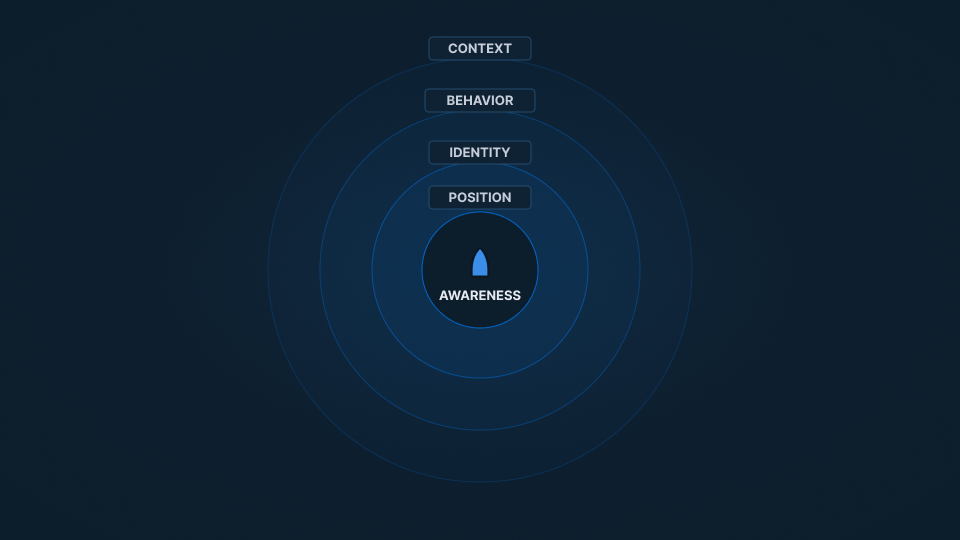
These layers reinforce one another. A position with no identity is only a contact, and an identity with no behavior is only a record. Awareness is the point where the layers combine into something a decision can rest on.
Why maritime domain awareness matters
The maritime domain carries the majority of world trade and sits at the center of sanctions enforcement, resource protection, and naval security. The stakes attach to specific problems:
- Sanctions evasion: vessels move restricted crude and cargo by disguising identity and location.
- Illegal fishing: unauthorized vessels operate inside exclusive economic zones and deplete protected stocks.
- Security and defense: naval and paramilitary activity shapes risk in contested and high-stakes environments.
- Safety and environment: collisions, groundings, and spills carry human and ecological cost.
- Commercial risk: insurers, financiers, and shippers price and manage exposure based on what vessels actually do.
In each case, the quality of the decision depends on the quality of the awareness behind it.
The base layer: what vessels report
The Automatic Identification System, or AIS, is the backbone of vessel tracking. Ships transmit their identity, position, course, and speed, and shore stations and satellites receive those broadcasts. AIS is the base layer of any maritime picture, and for the cooperative majority of traffic it is accurate and often sufficient on its own.
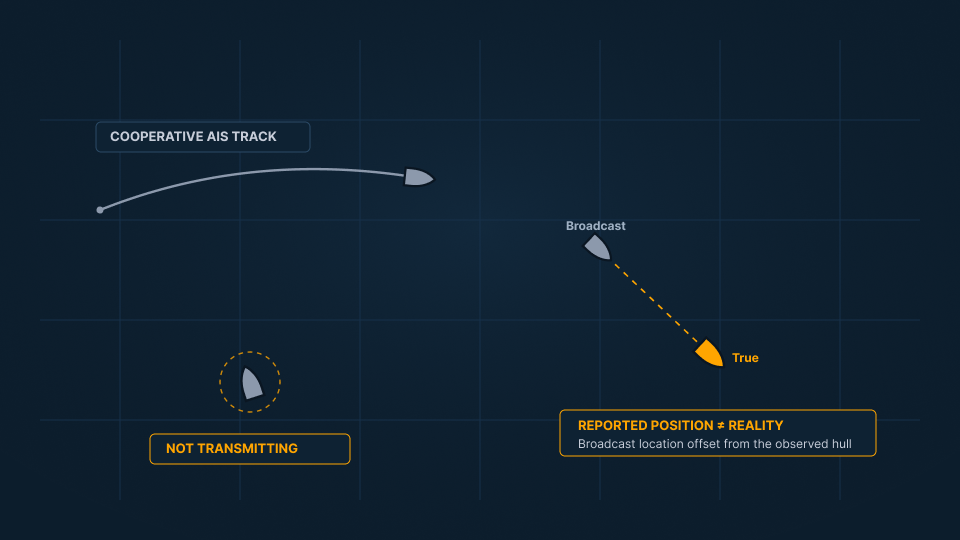
The important nuance is that AIS is voluntary. A vessel can operate without transmitting, and that is not inherently a problem: a small pleasure craft with no transponder is ordinary and unremarkable. A vessel can also transmit a position or identity that is not true. Because AIS is self-reported, it is the frame the rest of the picture is measured against, not the final word. Understanding it as a starting point, rather than a complete answer, is what the rest of the discipline builds on. (See: What Is AIS Spoofing.)
How imagery enriches the picture
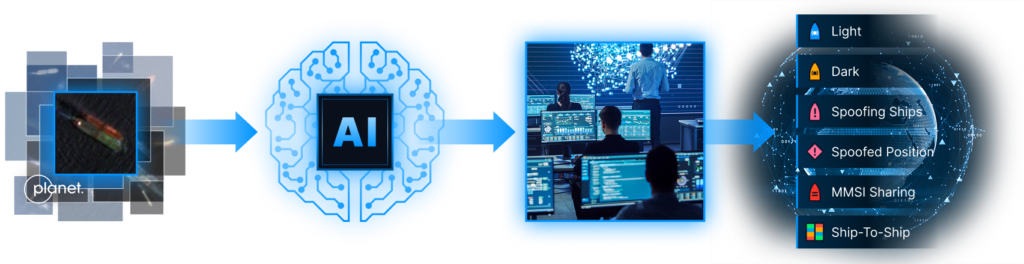
Enrichment comes from observing the same water directly, rather than relying on a vessel to report itself. Satellite imagery shows what is physically present, and it is sufficient for the great majority of the work. Where conditions or questions demand it, specific sensing types add particular strengths: synthetic aperture radar (SAR) images through cloud and darkness when optical cannot, electro-optical (EO) imagery adds visual detail in clear daylight, and radio frequency (RF) detection registers the signals a vessel emits. Whatever the source, its role is the same: to add ground truth to the reported picture. (See: How Satellite Vessel Detection Works.)
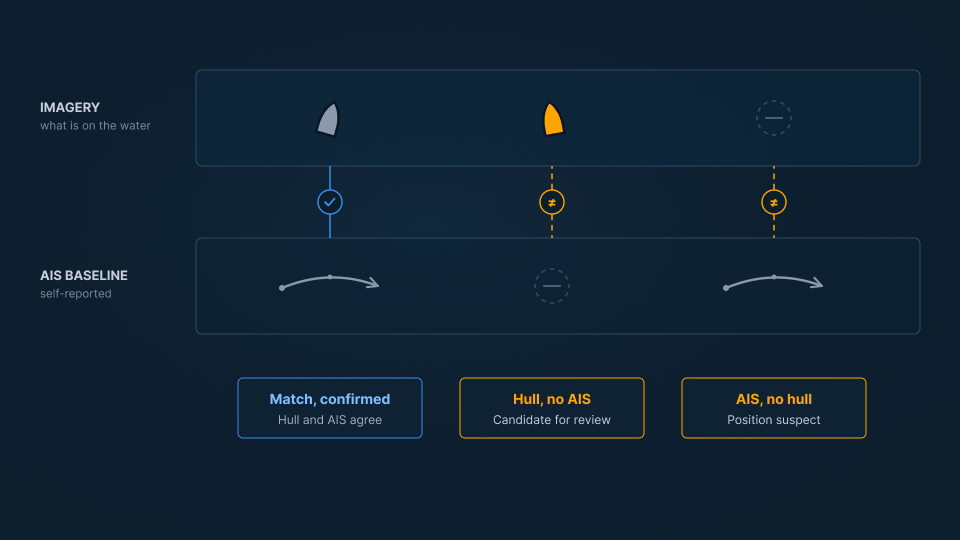
The value is in the correlation. Observed hulls are matched against the AIS baseline, and the relationship between the two is the finding. A clean match confirms a vessel. A reported position with no hull where it claims to be points to falsified AIS. A hull on the water with no AIS to account for it is a candidate worth examining. (See: How to Track Vessels Without AIS.)
From observation to judgment
Correlation surfaces candidates. Judgment turns a candidate into a finding, and that judgment is what makes awareness useful rather than merely voluminous.
Consider two vessels with no AIS transmission. A ten-metre pleasure craft with no transponder is almost certainly nothing, and treating it as a threat would waste attention. A fifty-metre cargo vessel with no transponder that recently called at a sanctioned port, or that held a rendezvous with another ship at sea, is worth a close look. The observation is similar in both cases. The significance is entirely different, and it comes from the vessel class, its history, and the context around it. (See: Understanding Deceptive Shipping Practices.)
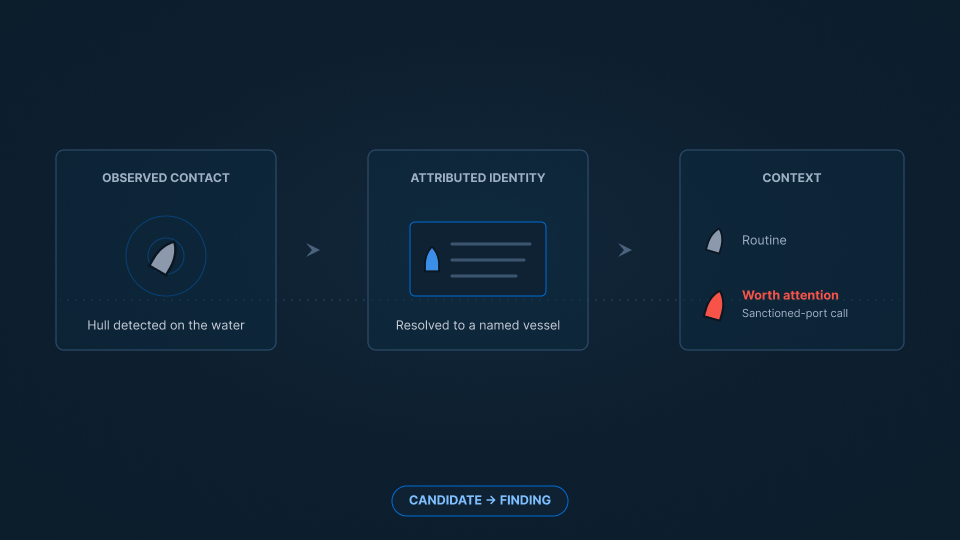
This is the work of maritime domain awareness: not producing more contacts, but determining which of them matter and why.
Who relies on maritime domain awareness
MDA supports a wide set of missions whose users share a common need for ground truth:
- Navies and coast guards monitoring activity in contested and high-stakes environments.
- Compliance and sanctions teams screening vessels and transactions for exposure.
- Maritime insurers and financiers assessing risk on specific hulls and voyages.
- Port and coastal authorities managing traffic, safety, and enforcement.
- Energy and commodity organizations tracking flows that move markets.
The missions vary, but the underlying requirement holds: an accurate, timely, and defensible understanding of what is happening at sea.
From awareness to decisions
Awareness is only useful when it changes what someone does. The gap most organizations face is less about the volume of data available and more about intelligence they can act on. SynMax delivers that through Theia, taking the AIS baseline, enriching it with imagery, and applying the judgment that identifies which vessels warrant attention. The result is not a feed of contacts to interpret. It is a capability: the answer to which activity matters, and why.
That is the standard we hold to across everything we build: Ground Truth for Every Decision.
If your team needs to know which vessels warrant attention across your waters, request a demo and we will show you what that looks like in your area of interest.