Deceptive shipping practices are the methods vessels and their operators use to hide the true nature, origin, destination, or ownership of a voyage or its cargo. Regulators, including the US Office of Foreign Assets Control and its counterparts in the UK and EU, have published guidance cataloguing these practices, because they are the operational signature of sanctions evasion, illegal trade, and other maritime crime. Understanding them is the foundation of maritime compliance and enforcement.
The practices differ in method but share one aim: to corrupt or evade the information the wider world relies on to know what a vessel is doing.
The main practices
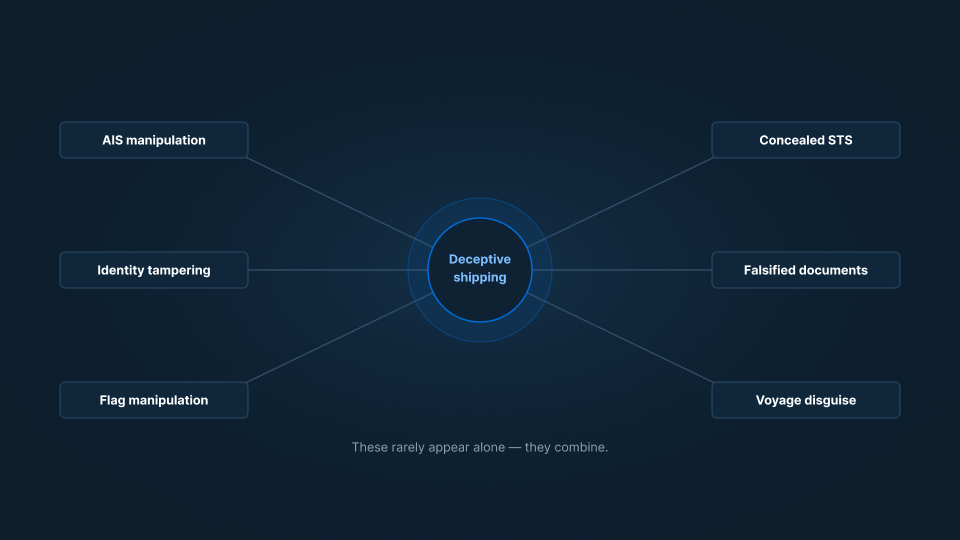
Most deceptive activity falls into a handful of recognized categories, and they are frequently combined:
- AIS manipulation. Disabling the transponder to create a reporting gap, or transmitting a false position or identity. (See: What Is AIS Spoofing.)
- Identity tampering. Altering or falsifying a vessel’s name, IMO number, or other identifiers, sometimes adopting the identity of a different ship.
- Flag manipulation. Repeatedly changing flag state, or using a registry chosen for weak oversight, to shed scrutiny. (See: What Are Flags of Convenience.)
- Concealed ship-to-ship transfers. Moving cargo between vessels at sea to break the paper trail linking cargo to its origin. (See: How to Detect Ship-to-Ship Transfers.)
- Falsified documentation. Forging or manipulating bills of lading, certificates of origin, and insurance paperwork.
- Voyage disguise. Routing to obscure a call at a sanctioned port, or misdeclaring the true load or discharge point.
Why they matter to compliance teams
For a compliance officer, insurer, or financier, these practices are the red flags that signal elevated risk. A single indicator is rarely conclusive, because many have innocent explanations, but a combination is telling. A vessel with a recent reporting gap, an opaque ownership structure, a history of flag changes, and a transfer at sea in an unusual location presents a profile that warrants examination before any transaction proceeds. Missing that profile can mean inadvertent exposure to sanctioned trade, with legal, financial, and reputational consequences.
Why detection needs more than documents
The common thread across these practices is that they target self-reported information. AIS, ownership records, flags, and documentation all describe what a vessel says about itself, and each can be manipulated. Screening paperwork alone therefore inherits every deception built into it.
The way through is to verify claims against something the vessel does not control. The self-reported picture is the base layer, imagery of the water establishes what is physically there and where, and correlating the two exposes the manipulations: a reporting gap filled by an observed transfer, a claimed identity contradicted by a measured hull, a route that observation does not support. No single anomaly condemns a vessel, and absence of a signal is not itself proof, so context and vessel history are what turn a set of red flags into a finding. (See: How Maritime Sanctions Evasion Works at Sea.)
From red flags to findings
Deceptive practices work by making a vessel look ordinary on paper. SynMax delivers the capability to see past that through Theia, checking the self-reported record against direct observation and vessel history, and applying the judgment that separates a genuine concern from an innocent anomaly.
That is the standard we hold to across everything we build: Ground Truth for Every Decision.
If your team needs to identify deceptive practices in the vessels you deal with, request a demo and we will show you what that looks like in your area of interest.