IUU fishing stands for illegal, unreported, and unregulated fishing. It is an umbrella term for fishing activity that breaks the rules meant to keep fish stocks sustainable and waters lawfully managed. The three words describe three distinct problems that often overlap in the same operation.
What the three parts mean
- Illegal fishing takes place in waters where the vessel has no authorization, or in violation of the laws and licenses that apply there. Fishing inside another state’s exclusive economic zone without permission is a common example.
- Unreported fishing is catch that is not declared, or is misreported, to the relevant authorities, which undermines the data that stock management depends on.
- Unregulated fishing occurs where no clear rules apply, for instance on the high seas beyond any single state’s jurisdiction, or by vessels flagged to states that do not participate in the relevant management body.
A single vessel can be involved in all three at once, which is why the category is treated as one problem rather than three separate ones.
Why IUU fishing matters
The consequences reach across environmental, economic, and security domains. It depletes fish stocks faster than they can recover, damaging food security for communities that depend on them. It undercuts operators who fish lawfully, distorting markets. It is frequently linked to other offenses, including forced labor and the same concealment behaviors seen in sanctions evasion. Coastal states lose both the resource and the revenue that lawful licensing would provide.
How IUU fishing is detected
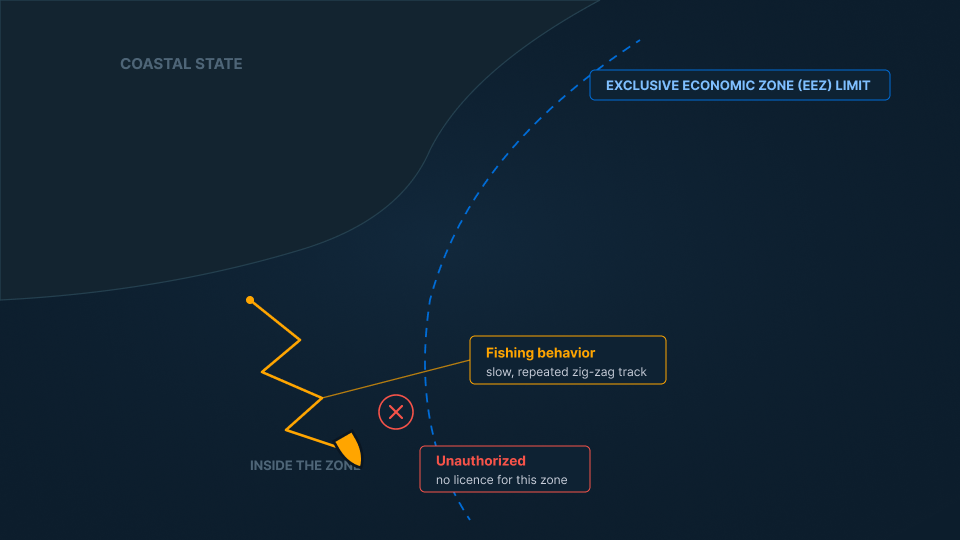
Detection begins with the self-reported picture and enriches it with observation of the water. Many fishing vessels transmit AIS honestly, so the interesting cases are where the reported picture and reality diverge. A boat fishing where it should not be will often stop transmitting or falsify its position, so imagery is used to establish what is actually present, and behavior analysis flags the movement patterns typical of fishing: slow, repetitive tracks worked over a defined area. (See: How Satellite Vessel Detection Works and How to Track Vessels Without AIS.)
Absence of AIS is not itself the finding, because fishing without a transponder is not inherently illicit. What matters is the combination: a vessel behaving as though it is fishing, inside waters where it has no authorization, without accounting for itself. That combination is what turns an observed hull into a vessel of interest. (See: What Is a Vessel of Interest.)
From open water to enforcement
Illegal fishing succeeds when no one is watching the right stretch of water at the right time. SynMax delivers the capability to change that through Theia, providing persistent awareness for the maritime domain and applying the judgment that distinguishes lawful activity from unauthorized fishing inside a protected zone.
That is the standard we hold to across everything we build: Ground Truth for Every Decision.
If your team needs to monitor fishing activity across your waters, request a demo and we will show you what that looks like in your area of interest.