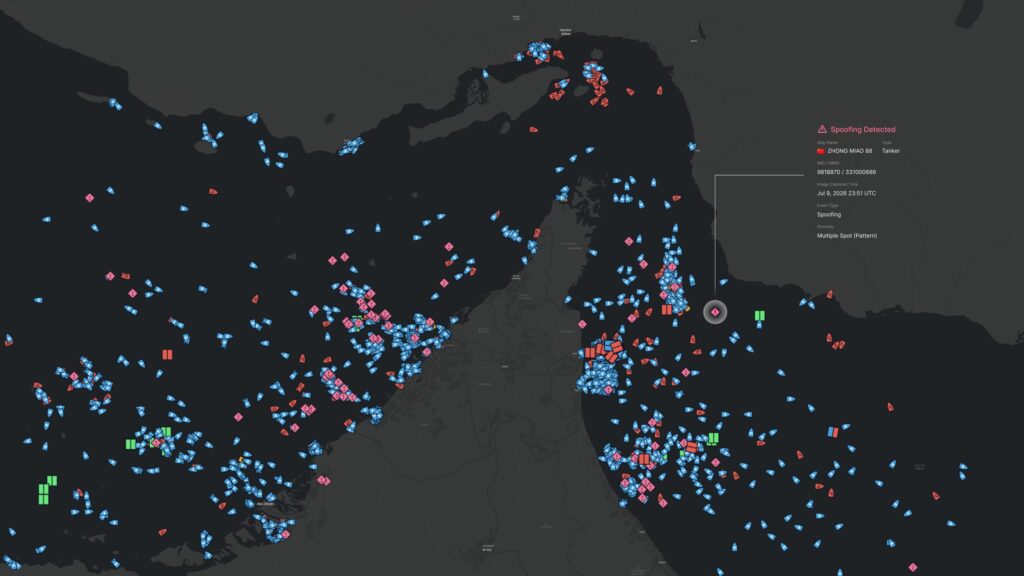
AIS spoofing is the deliberate manipulation of the Automatic Identification System so that a vessel broadcasts false information about its position, its identity, or both. The signal looks legitimate to anyone receiving it, yet it describes a ship that is somewhere it is not, or a ship that does not exist in the form it claims.
AIS is the base layer of maritime tracking, and it works on trust. Vessels transmit identity, position, course, and speed so that others can see and avoid them, and the system assumes the vessel is reporting itself honestly. Spoofing exploits that assumption. It does not remove a vessel from the picture; it plants something false inside it, which is what makes spoofing harder to catch than a vessel that simply is not transmitting.
How AIS spoofing works
Spoofing takes a few common forms:
- Position spoofing: the vessel transmits coordinates that place it somewhere other than its true location, sometimes thousands of miles away.
- Identity spoofing: the vessel broadcasts a false name, MMSI, or IMO number, borrowing or inventing an identity to mask its own.
- Manipulated navigation data: interference with satellite positioning feeds a false fix into the transmission, so even an otherwise honest broadcast carries the wrong location.
In each case the receiver sees a plausible track. Nothing in the signal itself reveals that it is fabricated.
Why vessels spoof
Falsifying AIS is a means to an end, and the end is usually concealment of an activity that would draw scrutiny:
- Moving sanctioned crude or cargo while appearing to sail an unremarkable route.
- Hiding a rendezvous where cargo is transferred between ships at sea.
- Fishing inside waters where the vessel has no authorization.
- Obscuring the true origin or destination of a voyage.
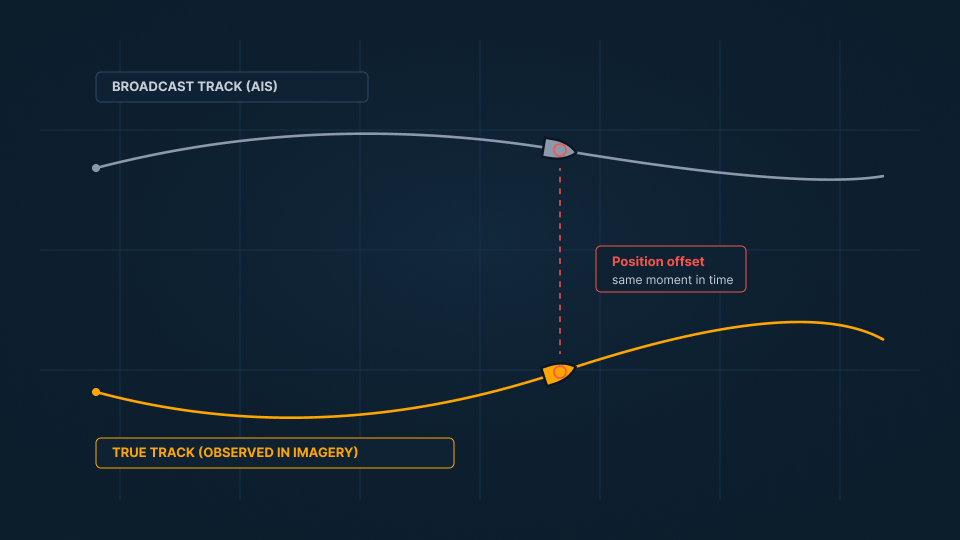
Spoofing compared with not transmitting
A vessel that transmits nothing simply has no AIS track. On its own that is unremarkable, because AIS is voluntary and many vessels operate without it for entirely ordinary reasons. Spoofing is different in kind. It is an active assertion of something untrue, made specifically to mislead. That is why a plausible but false track can be more dangerous than an absent one: it invites no suspicion and quietly corrupts the base layer everyone else relies on. Recognizing that distinction is central to maritime domain awareness. (See: What Is Maritime Domain Awareness.)
How spoofing is exposed
A self-reported claim can only be tested against something the vessel does not control. Imagery observes the same water directly and shows what is physically there, so the broadcast can be checked against reality. Where conditions require it, radar imaging adds coverage through cloud and darkness and radio frequency detection registers emitted signals, but imagery alone is usually enough to expose the contradiction. The discrepancies then speak for themselves: a transmitted position that no observation supports, movement that is physically impossible for the vessel type, or a hull whose measured dimensions do not match the identity it claims. (See: How Satellite Vessel Detection Works and How to Detect Dark Ships.)
Spoofing rarely appears alone. It is one technique within a wider set of deceptive shipping practices, and it tends to accompany the others. (See: Understanding Deceptive Shipping Practices.)
From signal to certainty
A position you cannot verify is a claim, not a fact. SynMax delivers the capability to tell the difference through Theia, checking what vessels broadcast against direct observation of the water so an analyst can separate a true track from a manufactured one, and knows which contradictions are worth acting on.
That is the standard we hold to across everything we build: Ground Truth for Every Decision.
If your team needs to see through falsified AIS, request a demo and we will show you what that looks like across your area of interest.