Sanctions risk in the maritime sector is not only a matter for enforcement agencies. Insurers, protection and indemnity clubs, banks, and traders all carry real exposure when a vessel they insure, finance, or transact with turns out to be involved in sanctioned trade. This analysis sets out the kinds of risk these teams face and why managing it depends on verifying what a vessel actually does, not only what its paperwork claims.
The kinds of exposure
Contact with a sanctioned or evasive vessel creates several overlapping risks:
- Legal and regulatory. Providing services to a sanctioned entity, even inadvertently, can breach sanctions law and trigger penalties and enforcement action.
- Financial. Exposure includes fines, frozen funds, unrecoverable claims, and the cost of unwinding a relationship discovered too late.
- Reputational. Association with sanctioned trade can damage standing with regulators, partners, and clients.
- Environmental and liability. Shadow-fleet vessels are frequently aging and inadequately insured, so an incident such as a spill can leave exposure that recognized cover would normally address.
These risks are heightened by the shadow fleet’s scale and by the deceptive practices it relies on. (See: Understanding the Russian Oil Price Cap and the Dark Fleet.)
Why paperwork is not enough
The standard defense is due diligence: know-your-customer checks, vessel and ownership screening, sanctions-list matching, and attestations of compliance. These are necessary, and they are also insufficient on their own, because the vessels of concern are the ones actively working to look compliant on paper.
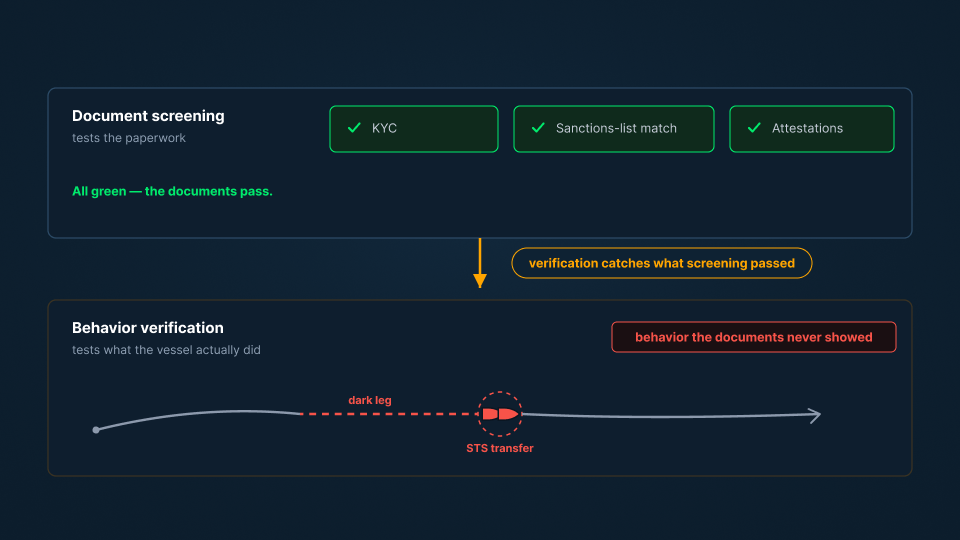
A vessel can present clean documentation, a plausible AIS track, and an attestation of price-cap compliance while having gone dark during a sensitive leg, transferred cargo at sea, or called at a port it did not declare. Deceptive practices are designed precisely to survive a paperwork review. Relying on self-reported information alone therefore inherits the deception built into it. (See: Understanding Deceptive Shipping Practices and How Maritime Sanctions Evasion Works at Sea.)
Verifying behavior, not just declarations
Managing the exposure means testing claims against independent evidence. The self-reported record is the base layer, imagery of the water establishes what a vessel actually did, and correlating the two exposes the gaps between claim and reality. Building this into a consolidated view of each vessel, its verified identity, its history, its behavior, and its associations, is what supports a defensible decision to proceed, decline, or investigate further. Because a vessel’s risk changes over time, that view has to be kept current rather than assessed once at onboarding. (See: How to Build a Vessel Risk Profile.)
From screening to certainty
Due diligence that ends at the paperwork can be defeated by a vessel built to pass it. SynMax delivers the capability to go further through Theia, verifying vessel behavior against direct observation and consolidating it into a current, defensible risk picture, so exposure is assessed on what a vessel does rather than what it declares.
That is the standard we hold to across everything we build: Ground Truth for Every Decision.
If your team carries sanctions exposure on the vessels you insure, finance, or trade with, request a demo and we will show you what that looks like in your area of interest.