
A ship-to-ship transfer, or STS, is the movement of cargo directly between two vessels while at sea rather than at a terminal. STS is a legitimate and routine operation in many contexts. It becomes a concern when it is used to obscure the origin, destination, or ownership of cargo, which is a recurring feature of sanctions evasion. Detecting STS means recognizing the observable signature of two vessels working together, and separating routine transfers from concealed ones. This guide walks through it.
The observable signature
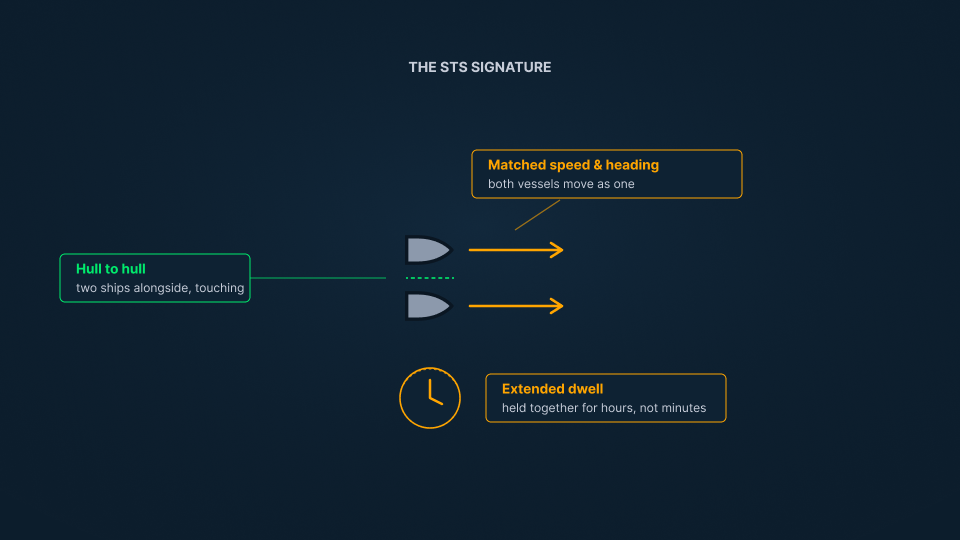
An STS has a distinctive footprint that imagery of the water can capture:
- Proximity: two vessels positioned hull to hull, far closer than normal traffic separation.
- Matched behavior: both vessels stationary or moving slowly at the same speed and heading, held together for an extended period.
- Location: often in open water or designated anchorages away from ports, sometimes in areas chosen for weak oversight.
- Reporting anomalies: one or both vessels may stop transmitting AIS or falsify position during the transfer.
Step 1: Detect the pair in imagery
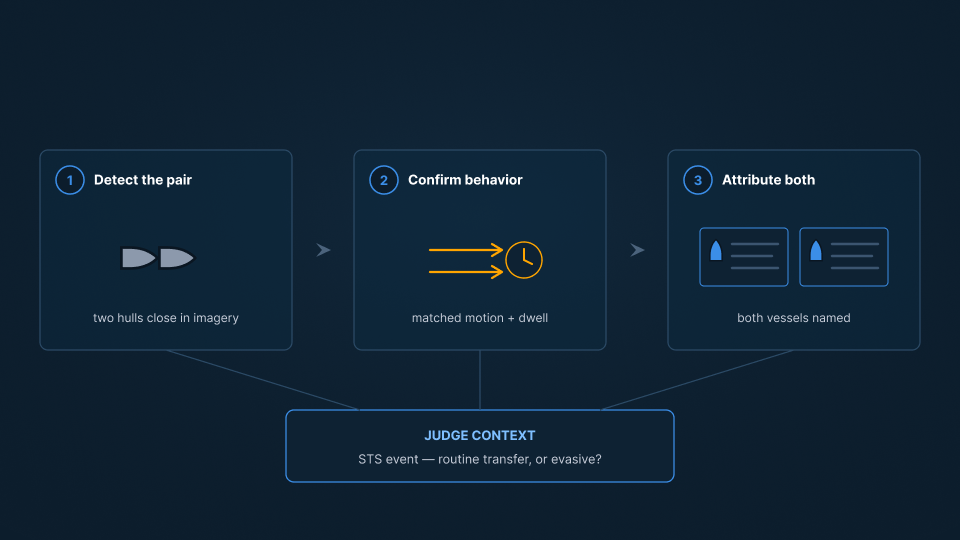
The first task is finding two hulls close enough and long enough to suggest a transfer. Imagery reveals paired vessels directly, showing two hulls alongside in a single frame regardless of what either is broadcasting. The AIS baseline complements this: positions that converge and then hold together flag a candidate, and any reporting anomaly around the event is itself informative. Because concealment is common in the cases that matter, imagery carries the load rather than the reported picture alone. (See: How to Detect Dark Ships.)
Step 2: Confirm the transfer behavior
Proximity alone is not proof, because vessels pass near each other constantly. What distinguishes an STS is dwell time and matched motion: two hulls that stay together, at low or zero speed, for a period consistent with transferring cargo. Correlating successive observations establishes whether the pairing persists or was momentary.
Step 3: Attribute both vessels
A transfer involves two parties, and understanding it requires identifying both. Physical measurements from imagery are matched against vessel records to resolve each hull, and their histories are examined. A transfer between two ordinary vessels in a normal anchorage reads very differently from one involving a vessel with opaque ownership and a history of flag changes. (See: How to Verify Vessel Identity with Satellite Imagery.)
Step 4: Judge context and intent
The final step places the transfer in context, because the same event can be routine or evasive. The vessel types, the cargo, the location, the reporting behavior, and any links to sanctioned entities together indicate which it is. A transfer in a normal anchorage between transparent operators is ordinary commerce. A transfer involving concealment, in a location chosen to avoid scrutiny, between vessels with troubling histories, is a strong indicator of sanctions evasion. The judgment, not the sighting, is the finding. (See: Understanding Deceptive Shipping Practices and How Maritime Sanctions Evasion Works at Sea.)
From rendezvous to evidence
A transfer meant to hide cargo depends on no one observing the moment two hulls meet, and on the event blending in with the routine ones. SynMax delivers the capability to catch and interpret it through Theia, combining imagery with the reported baseline and the histories of both vessels to tell a covert transfer from an ordinary one.
That is the standard we hold to across everything we build: Ground Truth for Every Decision.
If your team needs to detect transfers happening in your waters, request a demo and we will show you what that looks like in your area of interest.