
A ship-to-ship transfer, or STS, is the movement of cargo directly between two vessels at sea. It is a legitimate and common operation, used for entirely ordinary logistical reasons. It is also a recognized method of sanctions evasion, because a transfer at sea can break the documented chain between cargo and its origin. For compliance teams, the task is not to treat every STS as suspect, but to recognize the indicators that separate routine transfers from concealed ones. This guide covers those red flags and how to verify what actually happened.
The compliance red flags
Regulators have identified STS-related indicators that warrant closer examination. The concern rises as these accumulate:
- Location. Transfers in unusual or high-risk areas, away from established anchorages, or in waters chosen for weak oversight.
- Concealment during the transfer. One or both vessels going dark on AIS or transmitting a false position around the time of the transfer.
- Counterparty profile. Involvement of a vessel with opaque ownership, a history of flag changes, or links to sanctioned entities or ports.
- Documentation gaps. Transfers not reflected in the paperwork, or cargo details that change without explanation.
- Vessel condition and identity. An aging tanker with unclear insurance, or an identity that does not match observation.
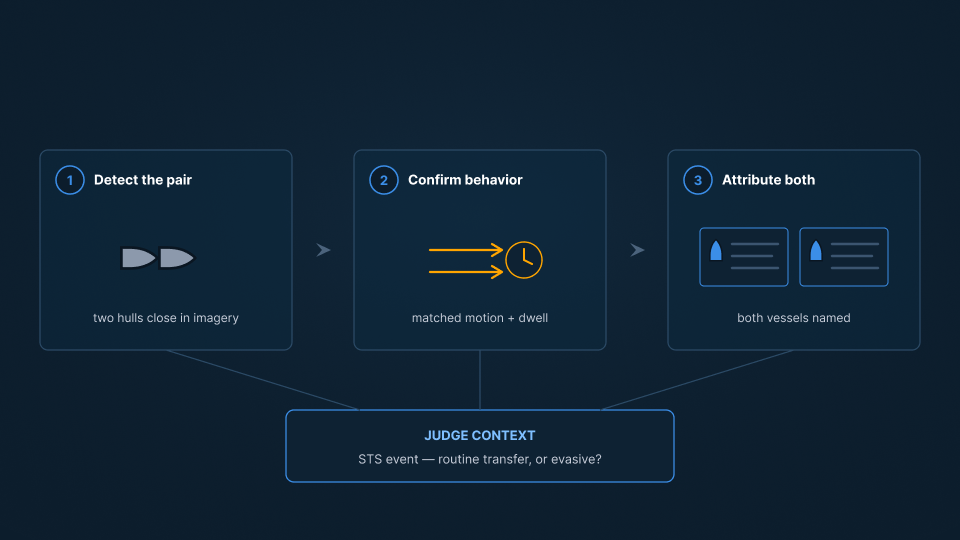
No single indicator proves misconduct, because legitimate transfers can share some of these features. The signal is in the combination, weighed against the vessels involved and the context. (See: Understanding Deceptive Shipping Practices.)
What compliance teams can do
Managing STS risk runs across the transaction lifecycle. Before engaging, screening and due diligence should assess the vessels, owners, and counterparties involved. Contractual terms can require disclosure of STS activity and prohibit transfers with sanctioned or high-risk parties. During and after, monitoring should confirm whether declared activity matches reality, because a clause is only as good as the ability to check it.
That last point is the crux. A counterparty can attest that no prohibited transfer occurred, and the documentation can support the claim, while a concealed transfer took place at sea. Verification therefore cannot rest on paperwork alone.
Verifying what actually happened
The self-reported record is the base layer, and imagery of the water is what tests it. A transfer meant to be invisible still appears as two hulls held alongside, matched in speed and heading, over an extended period. A dark leg around the transfer leaves a gap that observation can fill. Correlating the reported record against direct observation, and identifying both vessels involved, establishes whether a transfer occurred, with whom, and under what circumstances. (See: How to Detect Ship-to-Ship Transfers.)
This verification is central to managing sanctions exposure for insurers, financiers, and traders. (See: Maritime Sanctions Risk for Insurance and Compliance Teams and How Maritime Sanctions Evasion Works at Sea.)
From attestation to evidence
A red flag is a prompt to look closer, and looking closer means verifying behavior rather than trusting a declaration. SynMax delivers that capability through Theia, checking the reported record against observation and identifying the vessels involved, so a compliance decision rests on what happened rather than what was claimed.
That is the standard we hold to across everything we build: Ground Truth for Every Decision.
If your team needs to verify STS activity and manage the exposure it creates, request a demo and we will show you what that looks like in your area of interest.